
Holly's genius move
YouTube could make Holly Willoughby richer than ITV ever did

Holly Willoughby was one of the highest paid TV presenters in the UK, commanding a reported £1m a year from ITV for presenting the daytime TV show This Morning.
She presented the show for 14 years, but stepped down in 2023. Holly’s had various presenter roles since, but the latest has made headlines: last week she released the first full-length episode on her new YouTube channel, Holly Willoughby Together.
That’s right, Holly Willoughby is now a YouTuber.
Reviews for the first episode – a 52-minute cook-along with Hollywood’s most delightful olive-oil pusher, professional Italophile Stanley Tucci – have been almost universally dire, but the YouTube comments appear to tell a more mixed story. Yes, there are haters, but these are offset by a good number of positive comments from genuine fans.
Holly’s move led The Discourse for a few days over on LinkedIn, and Jamie East asked the obvious – and important – question: how on earth does she replace a million-pound ITV salary with YouTube?
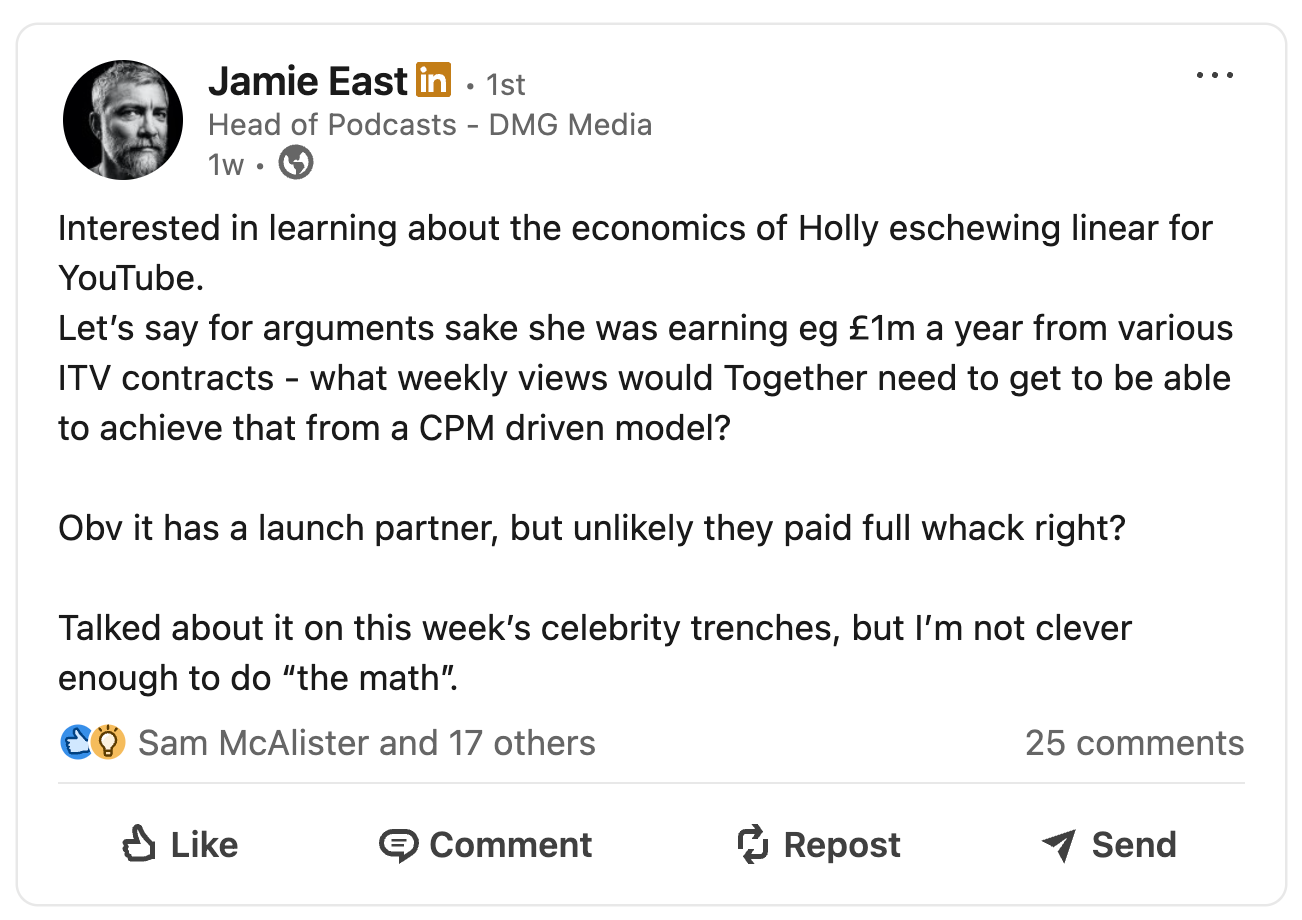
It’s a great question, and it got me thinking. What ARE the economics of a move like this for a premier TV presenter?
By my estimation this could be an absolutely genius move from Willoughby. Her ITV work has made her a multi-millionaire, but if she plays the YouTube channel right it could be her biggest earner yet.
So in this issue I’m taking a small break from the Podcast Metrics that Matter series to break down the likely economics of Holly Willoughby’s YouTube play – and what they mean for the rest of us.
Podcasting Jobs
🟡 Podcast Producer & Audio/Video Editor – SIFT Creative (£45,000 – £55,000)
🟡 Video Editor – Audio Always
🟡 Podcast Production Co-ordinator – Lower Street
🟡 Senior Podcast Producer – Global
Podcast Crew is the professional network connecting top podcast professionals with clients making astounding audio and video. Apply now to join the crew, or create a free hiring profile to find a podcast professional for your next project.
Let’s start with the central premise of the question: how does Holly replace her This Morning salary from YouTube?
My first point is: she doesn’t need to.
She’s been presenting for more than two decades, has pre-existing brand partnerships and has an estimated net worth north of £10m.
She’s doing ok for money.
So, why YouTube?
My guess: the YouTube channel is just the beginning. Holly is likely seeing this as the first investment in a much larger business portfolio, of which the YouTube show is a foundational element.
Holly already has massive reach, recognition and an audience who love her, but her presenting work on ITV positions her as a broadcaster with a one-way audience relationship. By launching her own content she is creating the opportunity to reposition herself as the convener of a community who gather around her as the host, and who feel a sense of personal relationship with her and the rest of the gang.
That’s a very strong foundation on which to build a lucrative business.
If I’m right, we’re likely to see a predictable sequence of next steps from Willoughby, Inc., predicated on the success of the YouTube show. I’ve detailed these below, roughly in order of how easy they are to start, which is more or less the reverse of how much they eventually pay.
If you’re wondering why you should care: this playbook is pretty well-defined now and, while Holly is playing the game at scale, these steps are proven and repeatable by creators at every scale and stage. I hope that by breaking down what I think Holly might do, there are some actionable lessons you can deploy to grow your shows and your business whether you’re reaching audiences in the hundreds or in the millions.
YouTube ads
Running ads on your channel is the first thing most people think of as YouTube revenue. It’s also the easiest, and the least rewarding. It’s where most people start, but not where they make their real money.
RPMs (Revenue per mille – how much channel owners receive per thousand views) on YouTube are around £1–5. Lifestyle content is one of the most valuable verticals, with loads of advertisers ready to pay top rates for brand-safe, aspirational content, so it’s likely Holly Willoughby’s show will hit the upper end of that range.
Let’s say she’s getting £4 per thousand views.
At these rates, to replace her This Morning salary on ad revenue alone she’d need 250 million monetised views a year.
(£1,000,000 / £4RPM) x 1000 = 250,000,000 views
At the time of publication the channel has released three full-length videos, receiving tens of thousands of views and reaching 14,300 subscribers. So, a solid start, but a long way to go.
But then, Holly doesn’t need to make a million in YouTube ads – and if you’re following a similar playbook, you shouldn’t be relying on them either. The revenue is nice to have, but the big money comes later.
Brand partnerships
Holly Willoughby Together launched with a “founding brand partner”: Voy, the glossy-looking private pharmacy specialising in weight-loss drugs and support.
It’s a no-brainer for Voy to get in on the ground floor with Holly’s channel: the launch announcement guarantees eyeballs in the early days and her audience is smack in the middle of their target market.
Will this be the most lucrative partnership the channel ever does? No. But it shows the direction Holly’s going in. Assuming this runs for the whole first series, I’d be staggered if they didn’t pay upwards of six figures for the launch partnership.
And that’s just the first deal.
Holly is already a proven brand magnet. She’s worked with a variety of brands including her current partners Garnier and M&S, for which she reportedly receives a six-figure fee.
The YouTube channel provides even more surface area for brand partnerships. Her full-length videos are between 40–75 minutes long. There’s LOADS of space in there for multiple host-read ads, not to mention the product placement opportunities: kitchenware, food products, clothes, and lifestyle or wellbeing products.
Brands have already proven they’ll pay a premium for Holly’s positive brand association, so with a growing audience and a savvy sales team I’d expect the channel itself to be capturing half a million in partnerships revenue in its first year.
Multi-platform campaigns
Holly’s Instagram account has nearly 8m followers, with another 2.4m on Facebook. The Together brand also has its own social accounts, and at the time of publication @HollyWilloughbyTogether is already at 40,000 followers.
With that sort of scale, brands will happily pay tens of thousands of pounds for a single Instagram post.
But social media is just one outlet.
The most lucrative deals are struck when a brand can reach an engaged audience across several different touchpoints in a multi-format campaign – especially when the creator or publisher can prove established trust with a brand’s target audience.
By launching her YouTube channel, Holly has created an additional step for her followers to take on their journey with her. On Instagram, they can get their Holly fix in short bites. On YouTube, they can spend hours with her.
The show is described in press coverage as a “multi-platform lifestyle series” – a phrase presumably taken from the press release given how it’s been repeated in multiple reports. This is not just about serving audiences; it’s a signal to advertisers and brand partners that the Together team will be going after multi-platform deals.
It’s no surprise, then, that Together is already a podcast – a fact most commentators seem to have missed. Although almost every review I can find discusses only the YouTube property, a quick search reveals full episodes are also available in video on Spotify and audio-only on Apple Podcasts.
I’d also expect to see Holly launch a Together newsletter in fairly short order because, as we know, building a mailing list is the best way to collect first-party data, learn about your audience and build a direct relationship with individual users.
By promising even more exclusive content and direct communication with her community in her video calls to action she’ll get her users to share their email addresses, creating a direct line of communication with a user base she can segment and market to directly.
With all of these elements working together, Holly will be the face of a powerful content machine with a clear user journey, which will become an extremely valuable asset to drive even more premium brand partnerships.
Memberships
Once the show is attracting a growing audience at scale across multiple platforms, Holly will be able to charge membership subscriptions for access to exclusive content.
It’s a proven model. In June 2026 The Sunday Times named Goalhanger Britain’s fastest-growing private company off the back of £37.9m in sales – of which a reported £15m comes from 250,000 paying subscribers.
Unlike traditional publishers, companies like Goalhanger – and potentially Holly’s new venture – are not tied to a single paywall or platform. At the YouTube News Summit earlier this year, Goalhanger co-founder Jack Davenport told me the company is focused on making it as easy as possible for people to pay them – which means turning on memberships wherever they can.
YouTube, Apple Podcasts and newsletter platforms all provide easy-to-use membership tools, while third-party platforms like Supporting Cast enable straightforward monetisation via Spotify.
If Holly can generate sufficient audience appetite, I’d expect to see her turn on memberships across multiple platforms within her new show’s first year.
Of course, you don’t need Holly’s reach to make memberships work. All of the platforms and tools I’ve listed above are just as available to the likes of you and me. With a little bit of audience trust and a valuable offering, memberships can become a meaningful revenue source for any show with an engaged audience.
Live events
Live, in-person shows have become a well-established extension of podcasting. This year’s Crossed Wires podcast festival attracted 50,000 people to Sheffield, UK, with 11 stages across the city hosting live podcast performances over four days. In September Goalhanger takes over the entire Southbank Centre for The Rest Is Fest – three days of live shows from across their network, and the biggest live event the company has attempted.
With her massive audience reach, positive image and, frankly, her fame, Holly would be very well positioned to take Together on the road in a series of live events, or host a live recording at a large London venue.
Go a step further and you can imagine an event built around the show itself: interactive fashion, food and wellness sessions, earning from both ticket sales and yet more brand partnerships. Everything from programmes to merch to signage is fair game for sponsorship – all of which make her multi-platform play even more lucrative.
Products
Holly already has her own “official lifestyle brand”, Wylde Moon: a sort of Goop-lite wellness platform selling a mix of aromatherapy products, astrological calendars and advice articles on alternative therapies.
With the advent of Together, though, I’d expect to see her product lines expand, probably focusing on more mainstream categories: a fashion line, signature perfumes, homeware... the usual fare for celebrity entrepreneurs.
At the upper end, Holly has examples in Kim Kardashian, Victoria Beckham and Gwyneth Paltrow – all of whom have leveraged their massive audience reach to grow giant businesses. But many solo creators – like Jay Clouse, for example – with a comparatively smaller audience have proven there is a model here that works regardless of scale: create content to grow an audience and build trust, then sell them products or services that genuinely work.
Intellectual property
The large streamers have all demonstrated, to varying degrees, a willingness to spend huge amounts of cash on acquiring exclusive rights to popular podcast and YouTube content. Netflix, Amazon, Spotify and SiriusXM have all struck deals collectively worth hundreds of millions of dollars for shows like Call Her Daddy, Jay Shetty’s On Purpose, The Rest Is Football, and more.
If Holly can prove her ability to grow an audience for her own content, one of the fastest ways to cash in would be an exclusive partnership with one of the large platforms.
Network ownership
Provided she can prove success by scaling her own brand, Holly could then replicate that business model across multiple different properties. These could all have different hosts and themes, but share an identifiable ethos and aesthetic.
Nic Newman’s May 2026 Reuters Institute report on podcast economics gave this a name: the show-based model. Rather than building around a masthead or a newsroom, podcast-first companies like Goalhanger and Italy’s Chora Media put talent and individual shows at the centre, then build communities of fans around each one.
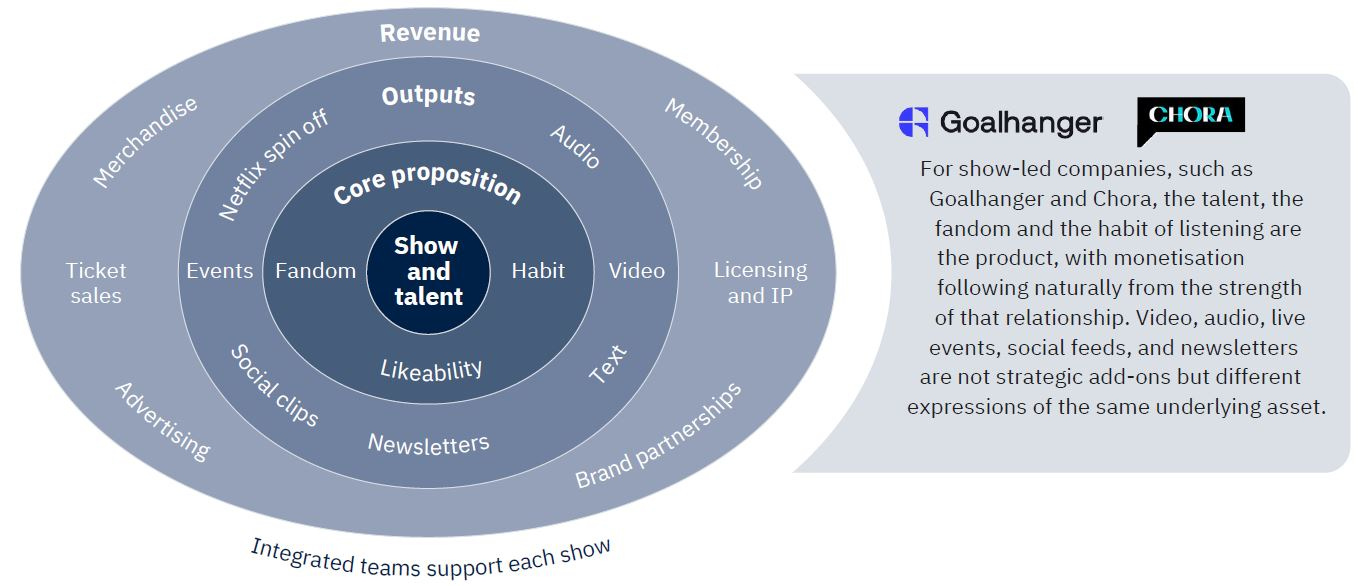
The same report also quoted IAB UK’s James Chandler saying creators will be the “dominant media owners by 2030” – a prediction Holly appears to be leaning into.
The key here is replicable scalability: find a system that works, rinse and repeat. If Holly can do this, she moves from being a presenter and personality to becoming the mogul behind a thriving and profitable content business. Given Together is produced by Hungry Bear Media, the production company owned by Holly’s husband Dan Baldwin, the business infrastructure to create such a network is already in place. They already make TV at scale. Building a second and third show around different hosts is a production problem they've solved many times over.
Can she pull it off?
All this depends, of course, on Holly Willoughby Together being good, and finding an audience that want more of what the show offers. And that is up to the team behind it. For my money, though, I wouldn’t write off Holly based on a few bad reviews in the legacy press. If she can nail this, she could be on to a massive winner.
What this means for you
Although I’m using Holly Willoughby’s new show as the example here, the approach is one that can be replicated, at least in part, regardless of scale.
Here’s the step-by-step playbook to follow:
YouTube ads: start with these. Easy to turn on, but very low returns.
Brand partnerships: grow a targeted audience that appeals to specific brands and promote their products to your community.
Multi-platform campaigns: develop content streams on a variety of platforms – social, video, audio, newsletters – and create opportunities for brands to partner across your whole ecosystem.
Memberships: offer exclusive content, access to your hosts and other perks. Make it easy for people to become members wherever they consume your content.
Live events: create opportunities for your audience to meet the show’s hosts – and each other – in real life. Earn from ticket fees and give brands something to sponsor.
Products: develop products (and/or services) that your audience will love, to turn hard-earned trust into purchases. You don’t need your own fashion line – yours might be simple digital products.
Intellectual property: with enough traction, your content can become a licensable or purchasable asset. Keep your rights and formats documented so you’re ready if the opportunity knocks.
Network ownership: if you’ve solved the scalability puzzle once, see if you can do it again with an adjacent show. Repeat and voilà – you’re a media mogul.
Your show is more than just a piece of content. Your audience is more than just a bunch of people who listen. If you can serve your audience with content they value, build trust with your loyal fans and find ways to delight them with memberships, events or products they desire, then your podcast can become the engine driving a much larger – and more profitable – business.
Finally, a huge thank you to the founding members of Podcast Strategy Weekly. Please do check out their fantastic products and services by clicking the links below:
Podschool: Want to start your own podcast? Launch faster and sound better with this step-by-step online course.
Jeremy Enns from Podcast Marketing Academy: providing unreasonably detailed podcast marketing strategy to attract & convert buyers.
Simon Elliot, Crowdfindervideo: Grow and engage your audience with a video podcast.
Mondo Metrics: Cross-platform analytics for podcasters and media companies.
JumpLink: Track clicks, drive interactions, and monetize your show notes.
Alitu & ThePodcastHost.com: Record, Edit & publish your show with Alitu (& learn how with ThePodcastHost.com!)
Steve Folland: Podcast editor – Audio, video, social. Sound good? You will.
Suze Cooper: freelance audio journalist supporting publishers, news rooms and media outlets.
School of Podcasting. Want to start or grow a podcast? This is where you begin.
When you become a founding member, you’ll get a full year’s subscription to Podcast Strategy Weekly, plus (more importantly) the opportunity to have your product or service featured in every single issue. That’s an ad for your business in front of 3,350+ readers every week, including senior decision makers in some of the world’s largest broadcasters, production companies, publishers and podcast networks – for just £199.
That’s it for now. Thanks so much for reading. If you enjoyed this, please forward it on to a colleague or friend who might also find it useful.
Until next time…
Chris
PS. I’m off on holiday next week. Are you getting away anywhere? Either way, I hope you’re having a marvellous summer!
Excellent, clear and very insightful. Thank you.